
Wind Zone I vs Wind Zone II in Texas: Where a Manufactured Home Can Legally Be Placed
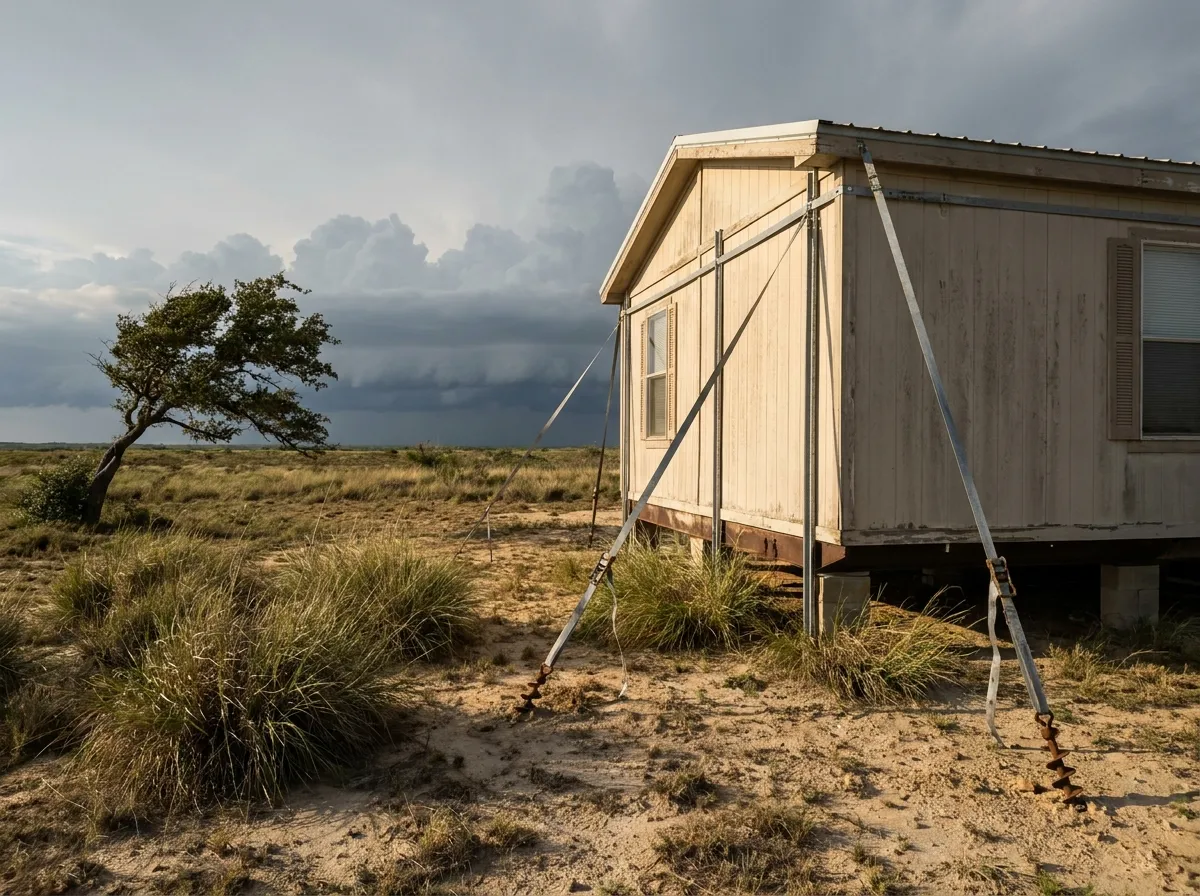
Here is a scenario we see more than you would think. Someone buys a well-kept manufactured home in the Austin area at a good price, plans to move it down to family land near Corpus Christi, and discovers late in the process that the home is not legal to install there.
Nothing was wrong with the home. It was built to the wrong wind zone for where it was going, and that is not a problem you fix with a heavier anchor kit.
What a wind zone actually is
The federal manufactured home construction standard at 24 CFR 3280.305 requires every HUD-Code home to be designed for one of three wind zones, and the zone is chosen based on where the home will be initially installed.
- Wind Zone I is the standard design. The rule sets it out as structural load requirements rather than a headline speed: the home and each of its wind-resisting parts must be designed for horizontal wind loads of not less than 15 psf and a net uplift roof load of not less than 9 psf.
- Wind Zone II is the first high-wind tier, corresponding to a 100 mph design wind speed.
- Wind Zone III is the highest tier, corresponding to 110 mph.
The differences are structural and they are built into the home at the factory. Heavier framing connections, different fastener schedules, reinforced roof-to-wall and wall-to-floor attachment, and a different anchoring and foundation design. You cannot upgrade a Zone I home into a Zone II home in the field in any practical way.
The one-way rule
This is the sentence that decides whether a deal works.
A home built to a higher zone can be installed in a lower zone. A home built to a lower zone cannot be installed in a higher one. A Wind Zone III home can sit in a Wind Zone I location. A Wind Zone I home cannot be installed in a Wind Zone II or Wind Zone III area.
That asymmetry is why direction of travel matters so much in Texas. Moving a home inland from the coast is generally fine on this point. Moving a home from Central Texas toward the Gulf is the move that fails.
Which Texas counties are Wind Zone II
Most of Texas, including the entire Austin and Central Texas market we work in, is Wind Zone I. Travis, Hays, Williamson, Bastrop, Caldwell, Comal and Bexar counties are Zone I, which is why the overwhelming majority of homes sitting on lots around Kyle, Buda, Pflugerville and Round Rock carry a Zone I data plate.
The Texas counties designated Wind Zone II in the federal basic wind zone map are the coastal tier:
Aransas, Brazoria, Calhoun, Cameron, Chambers, Galveston, Jefferson, Kenedy, Kleberg, Matagorda, Nueces, Orange, Refugio, San Patricio and Willacy.
Fifteen counties. If the home is going to any of them, a Zone I home is not an option, and that is a federal construction standard question, not a county preference you can negotiate.
The coastline clause most people have never read
There is a second restriction printed right on the data plate, and it catches people who assume a Zone II home solves everything.
The wind zone map on the data plate must carry this statement: "This home has not been designed for the higher wind pressures and anchoring provisions required for ocean/coastal areas and should not be located within 1500' of the coastline in Wind Zones II and III, unless the home and its anchoring and foundation system have been designed for the increased requirements specified for Exposure D in ANSI/ASCE 7-88."
So within roughly the first 1,500 feet of coastline, being a Zone II home is not automatically sufficient. The home plus its anchoring and foundation system have to have been designed for that exposure. On a bay-front or beach-adjacent lot, that is a question to put to the manufacturer and to a licensed installer in writing before money moves.
How to check your own home in five minutes
Two labels tell you everything, and we walk through both in detail in our guide to reading a HUD tag and data plate.
The HUD label is the small metal plate on the exterior of each section. It proves the home is HUD-Code and gives you a label number. It does not tell you the wind zone.
The data plate is the paper label inside the home, usually in a kitchen cabinet, a bedroom closet or on the inside of the electrical panel door. Under 24 CFR 3280.5 the data plate has to carry a reference to the roof load zone and wind load zone the home was designed for, along with duplicates of the maps from 3280.305. That is where the answer lives.
If the data plate is missing, which happens constantly on 1980s and 1990s homes, you are not out of options, but you are in a slower process. The manufacturer may be able to reissue the information from the serial number. If the manufacturer is out of business, the practical answer in a coastal placement is that you will likely need an engineer's evaluation, and many installers and insurers will simply decline rather than assume.
The insurance map is a different map
This is the part that causes the most confusion, and it is worth stating plainly: the HUD construction map and the Texas windstorm insurance map are not the same map, and they do not cover the same counties.
The Texas Windstorm Insurance Association is the residual windstorm and hail market for the coast. TWIA's designated catastrophe area is 14 first-tier coastal counties plus the part of Harris County east of Highway 146. Those counties are Aransas, Brazoria, Calhoun, Cameron, Chambers, Galveston, Jefferson, Kenedy, Kleberg, Matagorda, Nueces, Refugio, San Patricio and Willacy.
Compare that to the HUD list above and you will notice Orange County appears in the federal Wind Zone II list but not in TWIA's 14. Harris County appears in neither list as a whole, yet part of it is inside TWIA's territory. The two lists were compiled for different purposes by different bodies. Do not use one to answer a question about the other. Check both.
TWIA does write manufactured homes. What it also requires is a windstorm certificate of compliance, the WPI-8 family of certificates, for structures built, altered, remodeled, enlarged, repaired or added to on or after 1 January 1988. For a manufactured home that means the installation work needs to be documented and inspected properly, because an uncertified structure can end up ineligible. If you are buying on the coast, ask for the certificate before you close, not after. Our overview of manufactured home insurance in Texas covers how the wind and hail piece fits with the rest of a policy.
What this means if you are buying inland
If you are buying in the Austin area and keeping the home in the Austin area, wind zone is mostly a box to check. Confirm the data plate exists, note the zone, and move on.
It becomes a real issue in exactly two situations. First, if there is any chance the home gets relocated toward the coast later, a Zone I home limits your future buyer pool to inland buyers. Second, if you are buying a home that somebody already moved, verify it was legal where it landed. A Zone I home installed in Nueces County is a compliance problem that the current owner may not know they have, and it becomes yours at closing.
The practical checklist
- Find the data plate and photograph it. Record the wind zone and roof load zone.
- Confirm the destination county against the federal Wind Zone II list, not against a general hurricane map.
- If the destination is coastal, ask about the 1,500-foot coastline clause specifically.
- If the destination is in TWIA territory, ask about the WPI-8 certificate before closing.
- If the data plate is gone and the home is headed for the coast, budget time and money for an engineer, or walk.
None of this is exotic. It is just a set of checks that nobody performs until a deal is already three weeks old, which is the worst possible time to learn the answer.
This article is general information about federal construction standards and Texas insurance requirements for manufactured homes. It is not legal, engineering or insurance advice. Codes, county designations and insurer requirements change. Confirm current requirements with HUD, TDHCA, the Texas Department of Insurance and a licensed installer before making decisions.
Sources: 24 CFR 3280.305, Structural design requirements; 24 CFR 3280.5, Data plate; HUD Manufactured Home Labels; Texas Windstorm Insurance Association, Coverage and Eligibility; TWIA Windstorm Certification