
How to Read a Manufactured Home HUD Tag and Data Plate
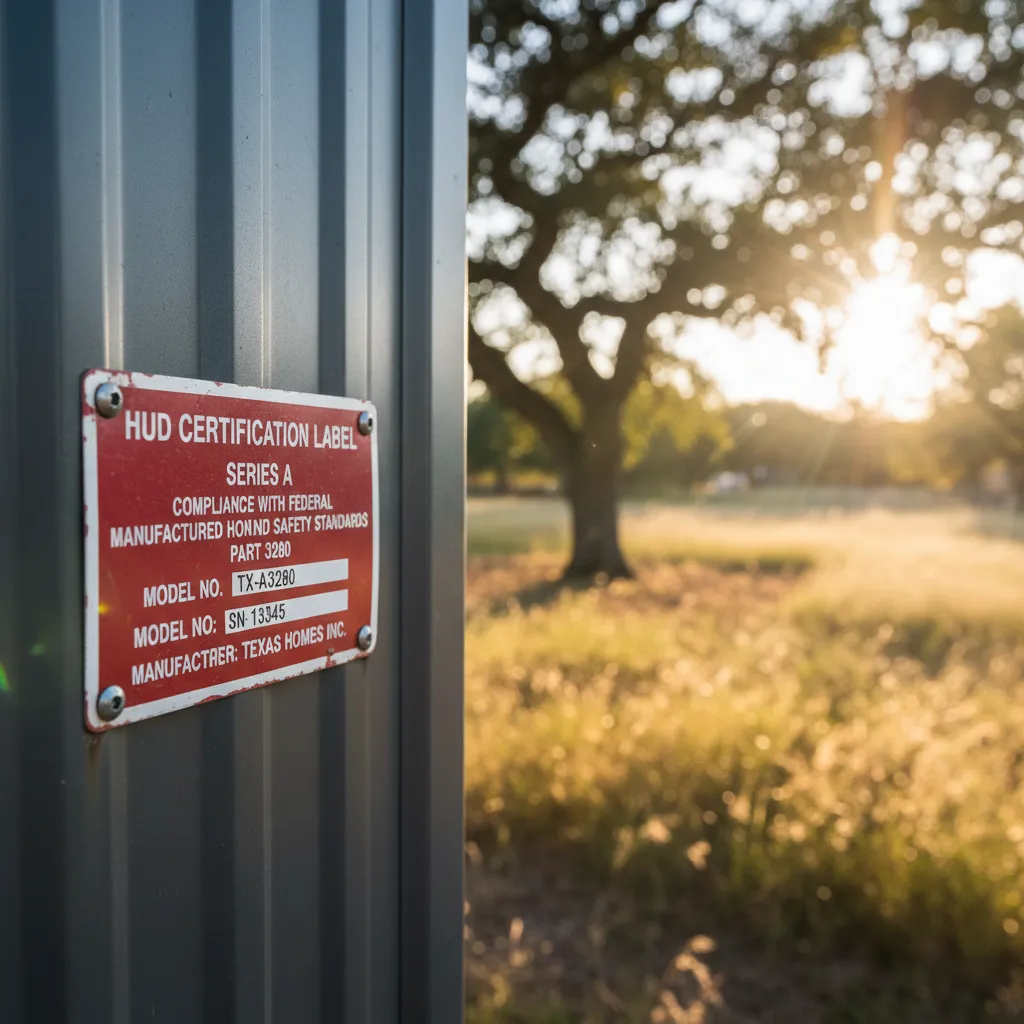
Every manufactured home built after June 15, 1976 has two federally required identifiers: the HUD tag (a red metal plate on the exterior) and the data plate (a paper label inside the home). Together they prove the home was built to the federal HUD Code and document the specific construction specs, wind zone, and thermal rating. If either is missing or unreadable, you cannot get FHA, VA, or most conventional financing, and resale value takes a significant hit. Here is exactly where to find both, what each field means, and how to replace missing labels.
Quick Answer: The HUD tag is a red metal plate on the exterior rear end of each section. The data plate is a paper label inside, usually in a kitchen cabinet, bedroom closet, or on the electrical panel cover. Always verify both before closing on a Texas manufactured home.
The HUD Tag (Red Certification Label)
The HUD tag is the small red metal plate, roughly 2 inches by 4 inches, permanently affixed to the exterior of each transportable section of a manufactured home. Its official name is the HUD Certification Label. Each label carries a unique alphanumeric serial like "TEX 123456", where the three-letter prefix indicates the state where the home was inspected (TEX = Texas, ALB = Alabama, etc.) and the six-digit number is sequential.
The tag proves three things at a glance:
- The home was built on or after June 15, 1976, making it a manufactured home rather than a pre-code mobile home.
- It was built to the federal HUD Code (24 CFR Part 3280), the construction and safety standard administered by the HUD Office of Manufactured Housing Programs.
- It was inspected by a HUD-approved third-party agency before leaving the factory.
Where to Find the HUD Tag
Look on the exterior of the home, typically:
- Rear end wall of each section (most common)
- Near the bottom edge of the siding, about 1-2 feet above the skirting line
- On single-wides: one tag on the rear
- On double-wides: one tag on each half, both on the rear ends
- On triple-wides: three tags, one per section
If the tag has been painted over, you can often still read it by carefully scraping the paint off the raised lettering. Do not remove the tag. Removal is a federal violation and destroys resale and financing eligibility.
The Data Plate (Compliance Certificate)
The data plate is a paper label about the size of a standard sheet of paper. It is affixed inside the home in a location chosen by the manufacturer, which makes finding it part scavenger hunt. The data plate contains far more detail than the exterior tag and is required reading for any serious buyer or inspector. Our manufactured home inspection guide covers how professional inspectors verify it.
Where to Find the Data Plate
Check these locations in order of frequency:
- Inside a kitchen cabinet door (often the one under the sink)
- Inside the master bedroom closet (on the wall or door)
- On the inside of the utility room or laundry closet door
- Inside the electrical panel or next to the main breaker
- On the back of the primary bedroom door
- Inside a hallway linen closet
What the Data Plate Shows
A complete data plate includes:
- Manufacturer name and address
- Serial number (usually starts with factory code + sequential number)
- Model number and model name
- Date of manufacture (month and year)
- HUD label numbers (matching the exterior tags)
- Wind zone (Zone I, II, or III) with a US map showing zones
- Roof load zone (North, Middle, or South)
- Thermal zone (Zone 1, 2, or 3, based on heating degree days)
- List of major appliances installed (HVAC, water heater, range)
- Energy performance ratings (U-values for walls, floor, ceiling)
What the Zones Mean
Three zones on the data plate determine where the home is appropriate to install. Most of Texas is covered by specific zones that affect insurance, financing, and installation requirements.
| Zone type | Rating | Meaning | Texas applicability |
|---|---|---|---|
| Wind Zone I | Up to 70 mph | Inland, low wind | Most of Central and West Texas |
| Wind Zone II | Up to 100 mph | Coastal and hurricane-adjacent | Coastal counties, East Texas |
| Wind Zone III | Up to 110 mph | Extreme coastal | Immediate Gulf Coast (rare) |
| Roof load (North) | 40 psf | Heavy snow areas | Not applicable in TX |
| Roof load (Middle) | 30 psf | Moderate snow/ice | North Texas (rare use) |
| Roof load (South) | 20 psf | Minimal snow | Most of Texas |
| Thermal Zone 3 | Lowest insulation | Warm climates | South/Central Texas |
| Thermal Zone 2 | Middle insulation | Mixed climates | North Texas |
Installing a Wind Zone I home in a coastal Zone II county can void insurance coverage and violate local installation rules. Always match the data plate's wind zone to where the home sits today.
Why Missing Tags Kill a Deal
If a manufactured home does not have a visible HUD tag or a readable data plate, the consequences are immediate:
- No FHA, VA, USDA financing. These programs explicitly require a HUD certification label. Underwriters will not close without it.
- Most conventional and chattel lenders refuse too. A few will accept a HUD Label Verification Letter in lieu of the physical tag.
- Insurance gets harder and more expensive. Some carriers will not write a policy, and those that do charge more.
- Resale value drops 10-25%. The next buyer faces the same financing and insurance problems you faced.
- TDHCA Statement of Ownership complications. Missing documentation can delay or block SOL transfer in Texas, adding weeks to closing.
For a deeper dive on how condition and documentation affect value, read What is my mobile home worth. For the broader Texas regulatory framework, see Texas manufactured home regulations.
How to Replace a Missing Label or Data Plate
If the tag is missing, you request a HUD Label Verification Letter from the Institute for Building Technology and Safety (IBTS), a HUD-authorized agent. The letter confirms the home was built to HUD Code and identifies the original label numbers.
Steps to request a Label Verification Letter
- Gather documentation: Manufacturer name, serial number, date of manufacture. These are all on the data plate if the data plate is still readable.
- Submit an application through IBTS (search "IBTS HUD Label Verification Letter"). Cost is around $100 per section.
- Wait 4-6 weeks for processing. Expedited options exist for an added fee.
- Provide the letter to your lender, insurer, and title company. FHA, VA, and most conventional lenders accept the letter as a substitute for the missing tag.
For missing data plates, IBTS can also issue a Data Plate Replacement. This is more expensive and takes longer because the manufacturer records must be retrieved. If the manufacturer is out of business, retrieval can be difficult.
What to Do Before You Buy
Every manufactured home inspection should include tag and data plate verification. Before you close:
- Walk the exterior and photograph every HUD tag on every section.
- Find the data plate inside and photograph all fields.
- Match the HUD label numbers on the tag to the numbers listed on the data plate. They should agree exactly.
- Compare the date of manufacture to the home's stated age. A "1998 manufactured home" with a 1994 data plate is either mislabeled or has been misrepresented.
- Note the wind zone, roof load, and thermal zone. Confirm they are appropriate for your installation location.
- Give copies to your lender, title company, and insurance agent.
Buying a Texas manufactured home and not sure what to look for on the tag and data plate? Mobile Buy Buy verifies HUD documentation on every home we help clients purchase. Call (737) 777-9437 or send a buyer inquiry and we will walk the home with you to confirm everything matches before you write an offer.
Frequently Asked Questions
Where is the HUD tag on a manufactured home?
The HUD tag is a small red metal plate attached to the exterior of each transportable section, typically at the rear end wall about 1-2 feet above the skirting line. A single-wide has one tag, a double-wide has two, and a triple-wide has three. Each tag shows a unique alphanumeric HUD label number.
Where is the data plate located?
Inside the home, usually on the inside of a kitchen cabinet door, inside a bedroom or utility closet, on the back of the master bedroom door, or inside the electrical panel cover. It is a paper label roughly the size of a sheet of paper showing manufacturer, serial, date of manufacture, wind zone, roof load, and thermal zone.
What do I do if the HUD tag is missing?
Order a HUD Label Verification Letter from the Institute for Building Technology and Safety (IBTS). It costs around $100 per section and takes 4-6 weeks. You will need the manufacturer name, serial number, and date of manufacture. FHA, VA, and most lenders accept the letter in lieu of a physical tag.
Why does the HUD tag matter for financing?
The tag proves the home was built to federal HUD Code on or after June 15, 1976, which is required for FHA, VA, USDA, and most conventional and chattel loans. No tag and no Label Verification Letter means no loan. The tag is also required for insurance underwriting and strongly affects resale value.
What is a wind zone and why is it on the data plate?
Wind zone indicates the maximum design wind speed the home was built to withstand. Zone I is inland (70 mph), Zone II is coastal (100 mph), and Zone III is extreme coastal (110 mph). Installing a Zone I home in a Zone II county can void insurance coverage and violate local installation requirements.
Can I paint over the HUD tag?
Avoid it, but it is not illegal. If the tag has been painted over, you can gently scrape the paint off the raised letters to read it. Do not remove the tag entirely. Removing a HUD certification label is a federal violation and destroys the home's financing eligibility.