
Solar and Energy Retrofits on an Older Texas Manufactured Home: What Actually Pays Back
Every summer somebody asks us about putting solar on a manufactured home, and the honest answer is usually "probably not, and here is what to do with that money instead."
That is not an anti-solar position. It is a structural and economic one, and both halves have gotten more pointed recently.
The roof problem is real, not an excuse
A manufactured home roof is not a small site-built roof. It is engineered to a federal standard for a home built on a chassis and transported down a highway, which produces several constraints.
The framing is lighter and shallower. Roof members in a manufactured home are sized for the design loads in the HUD Code, with weight and transport height as real design drivers. A rooftop array adds permanent dead load across the roof plane and wind uplift at the attachment points. Whether a given roof can take it is an engineering question, not a sales question, and a competent installer will ask for the manufacturer's information before answering.
Older homes often have the wrong roof plane entirely. Low-slope and gently arched metal roofs, common on Texas homes from the 1970s through the early 1990s, give almost no tilt and no good way to attach racking without penetrating the roof in dozens of places. Every penetration in a low-slope metal roof is a future leak.
The roof is narrow. A single-section home is around fourteen feet wide. After setbacks from the edges, vents, and the roof jack for the furnace, the usable array area is limited, which caps the system size regardless of how much power you use.
Orientation was decided by the driveway. A manufactured home was set on its lot based on the lot shape, the access, the septic and where the utilities come in. Nobody rotated the home for solar exposure. If your long roof faces north and south, you are fine. If it faces east and west, which is common, your production is meaningfully worse and there is no fixing it.
If the home is not on land you own, it is the wrong asset to improve. A chattel home in a community may be moved someday, and an array does not relocate well. It also will not necessarily show up in value. Our comparison of a community lot versus private land is the relevant background there.
Ground mount is the real option, when you own the land and have room. It removes the structural question, lets you aim the array properly, keeps every penetration out of your roof, and makes maintenance easy. It costs more in racking and trenching, and on a manufactured home it is usually still the better engineering answer.
What changed in 2026, and it matters
For years the payback math on residential solar leaned on the federal Residential Clean Energy Credit under Internal Revenue Code Section 25D, which covered 30 percent of the cost of a homeowner-owned system.
That credit ended. Under the law signed on 4 July 2025, Section 25D no longer applies to expenditures where installation was completed after 31 December 2025. The statute treats an expenditure as made when the original installation is completed, so the completion date governs, not the contract or payment date. The companion Section 25C energy efficient home improvement credit ended on the same timeline.
The practical consequence for 2026: if a salesperson's payback math includes a 30 percent federal credit, the math is wrong. Ask them to run it again without it. Many proposals do not survive that. Verify the current state of any credit with the IRS directly, because tax law moves.
The other thing people assume: Texas does not have statewide net metering
There is no statewide net metering policy in Texas. What you get for exported power depends entirely on who serves you. In the deregulated market, a number of retail electric providers offer solar buyback plans on varying terms. Municipal utilities and cooperatives set their own. Austin Energy uses a Value of Solar credit, which credits generation at a rate the utility calculates rather than offsetting your bill one for one at retail. Out in the rural Austin metro, Pedernales and Bluebonnet have their own terms.
Get your provider's current buyback terms in writing before you buy anything. "You sell it back to the grid" is not a description of any actual Texas program.
Where the money actually goes further
Here is the part worth taking seriously. On an older manufactured home, the building is usually leaking so much conditioned air that generating power is solving the wrong problem.
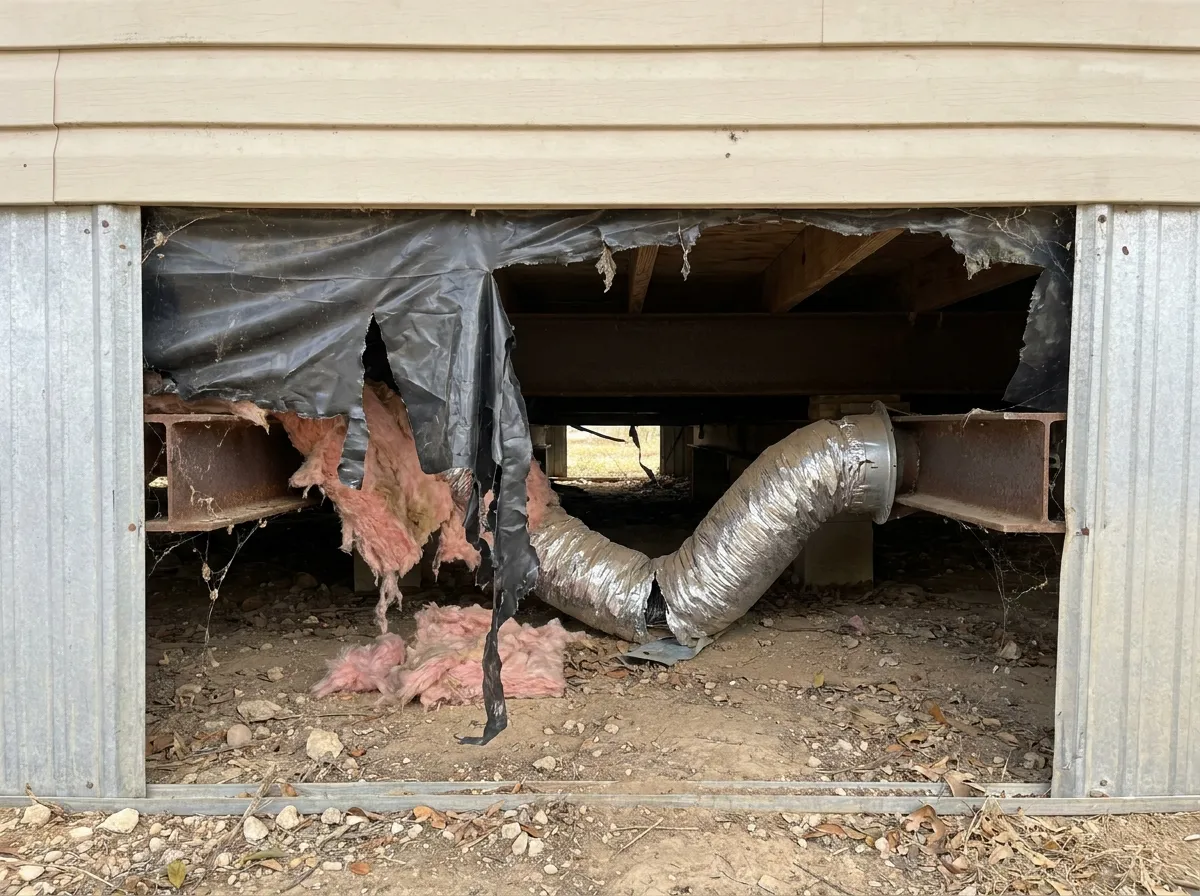
Ducts, and specifically the crossover duct. This is the single highest-return item on most multi-section homes and it is invisible unless you crawl under there. The crossover duct runs under the home between the two halves, and on a home that has been down for twenty years it is routinely crushed, disconnected, torn open by animals, or lying in the dirt. DOE's energy conservation standards for manufactured housing address exactly this, calling for crossover ducts and other ducts in unconditioned space to be insulated to R-8, and requiring that on multi-section homes the crossover duct be installed with all seams and joints tightly sealed against leakage and not resting on the ground. If yours is on the ground, you are air conditioning your crawlspace.
The belly board. The bottom board under the floor holds the floor insulation in place. Plumbers cut it, animals tear it, and once it is open the insulation sags out and the ducts sit in outside air. Repairing the belly and restoring the insulation is unglamorous and it works.
Air sealing at the obvious leaks. Plumbing and electrical penetrations through the floor. The marriage line. Around the furnace and water heater closet. Door weatherstripping and thresholds. None of it is expensive and all of it compounds.
Shade and west-facing glass. In Central Texas, afternoon sun on west windows is a large share of the cooling load. Solar screens, awnings and shade trees on the west side are cheap relative to almost anything else on this list.
HVAC, sized correctly. Older manufactured homes frequently have oversized equipment, which short-cycles and dehumidifies poorly in Texas humidity, or an electric resistance furnace that is expensive to run. Replacing a failing unit with a properly sized heat pump changes the bill. Replacing a working unit early usually does not.
Reflective roof coating on a low-slope roof. A bright coating on an intact metal roof cuts the summer heat load noticeably, and it is maintenance the roof needed anyway.
Windows, last. Single-pane aluminum frames are common on older homes and they are genuinely bad. They are also the most expensive item here per unit of benefit. In many Texas homes, storm windows, low-e film and exterior shading deliver more per dollar than full replacement.
Our guide to energy efficiency upgrades for older manufactured homes goes through the rest of the list, and skirting and underfloor ventilation matters more than people think, because the crawlspace is where half of this lives.
Why new homes feel so different
DOE adopted the first federal energy conservation standards for manufactured housing, developed from the 2021 International Energy Conservation Code, covering the thermal envelope, air sealing, installation of insulation, duct sealing, HVAC, service hot water, mechanical ventilation fan efficacy and heating and cooling equipment sizing. Separately, the ENERGY STAR Manufactured New Homes program sets its own requirements above the baseline.
Your 1996 home was built to none of that. Every item in the retrofit list above is closing some part of that gap, and closing it costs far less than generating your way around it.
One program worth knowing about
TDHCA administers the Weatherization Assistance Program in Texas using U.S. Department of Energy and LIHEAP funding, delivered through subrecipient agencies covering all 254 counties. The work it funds is close to the list above: caulking, weather stripping, ceiling, wall and floor insulation, patching holes in the building envelope, duct work, and tune-up, repair or replacement of inefficient heating and cooling systems. Eligibility is income based.
If anyone in the home might qualify, make that call before spending your own money.
The honest summary
On an older Texas manufactured home, in 2026, with no federal residential credit and no statewide net metering, rooftop solar has to clear a high bar before it makes sense. A ground mount on land you own is a different and much better proposition.
Sealing the ducts, fixing the belly, shading the west glass and right-sizing the HVAC are less interesting to talk about, cost a fraction as much, and produce a result you feel in July. That is where we would start, and we are comfortable telling a salesperson so.
This article is general information about energy retrofits, federal tax credits and Texas electricity programs. It is not tax, engineering or investment advice. Tax law, utility programs and product specifications change. Confirm current tax treatment with the IRS or a tax professional, and confirm buyback terms with your own electricity provider.
Sources: U.S. Department of Energy, Manufactured Housing; DOE Energy Conservation Standards for Manufactured Housing, final rule; ENERGY STAR Manufactured New Homes program requirements; IRS Residential Clean Energy Credit; TDHCA Weatherization Assistance Program