
Recoat or Replace? Deciding What to Do With a Texas Manufactured Home Roof
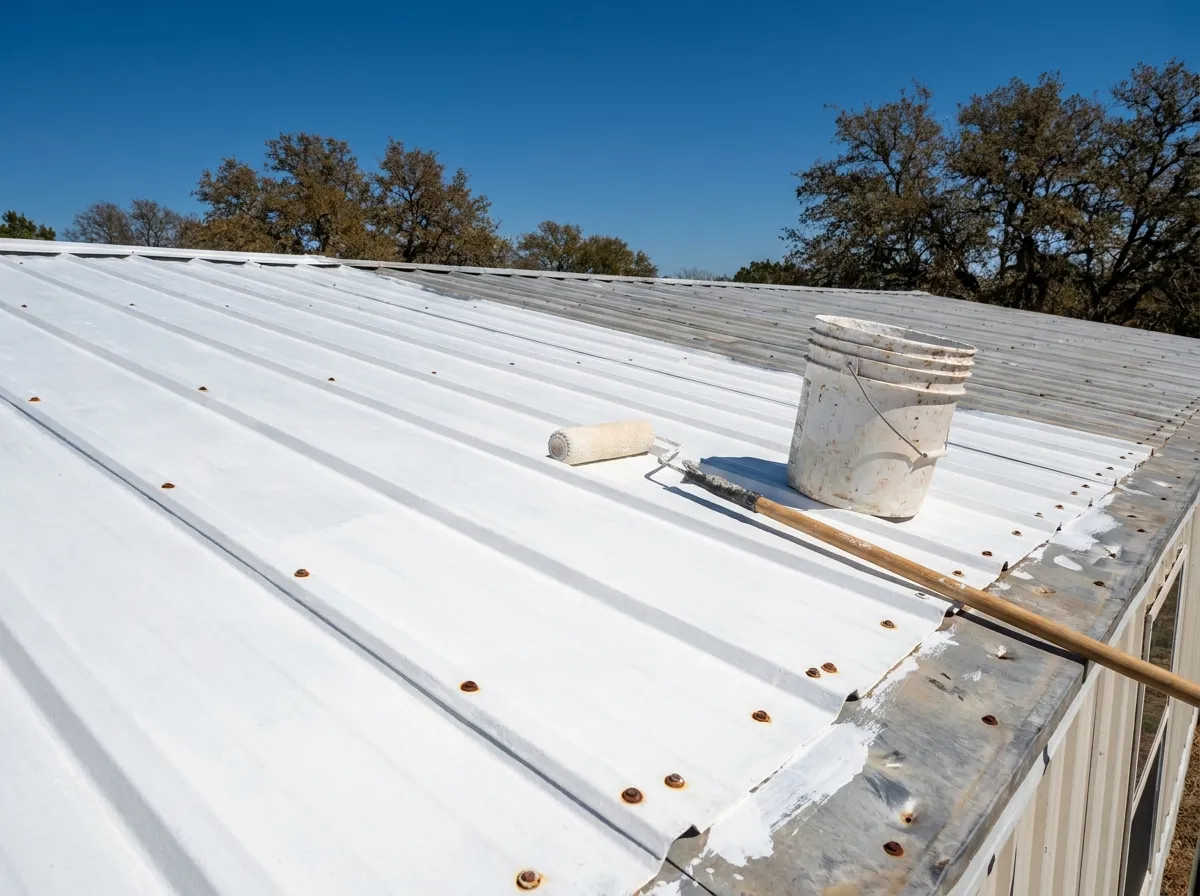
Almost every used manufactured home we look at in Central Texas has had something done to the roof, and the quality of that something ranges from proper maintenance to a bucket of driveway sealer and a good story.
Knowing which one you are looking at matters, because it is the difference between a roof with years left in it and a roof that is already leaking under a fresh white surface.
What Texas actually does to a roof
Two forces, and they damage roofs in different ways.
Heat and ultraviolet. A dark low-slope roof in Central Texas gets brutally hot in July and August, then cools fifty degrees or more overnight. That daily expansion and contraction works fasteners loose, opens seams, and drives sealants and coatings past their elasticity. Ultraviolet exposure degrades asphalt-based products and chalks acrylics. Heat is the slow failure mode, and it is the one a coating program is designed to manage.
Hail. Texas consistently ranks first in the country for major hail events in NOAA's storm reports, and the corridor from Dallas through the Hill Country and down toward San Antonio takes a disproportionate share of it. Hail is the sudden failure mode. On a metal roof it dents and can fracture coatings and seam sealant. On shingles it bruises the mat, knocks off granules and shortens the remaining life without necessarily producing a leak on day one.
The practical implication is important. A coating program addresses heat. It does not address hail. A roof that has taken a real hail event is a claim question, not a maintenance question.
Know which roof you have
Manufactured home roofs in Texas fall into a few clear categories, and the right answer depends entirely on which one is over your head.
Low-slope or arched metal. Common on homes from the 1970s through the early 1990s. A galvanized or aluminum panel roof with seams down the length, often gently bowed rather than flat. These were designed to be maintained with periodic coating. That is not a shortcut, it is the intended care regime.
Pitched shingle over trusses. Standard on most homes from the mid 1990s forward. Structurally this behaves like a small site-built roof: decking, underlayment, shingles. You do not coat it. When it is done, it gets torn off and replaced.
Membrane. Some homes have a TPO, EPDM or similar single-ply membrane. These have their own repair systems and their own compatible coatings, and using the wrong product on them causes real damage.
A previous roof-over. Metal or shingles installed on top of the original roof at some point. Very common on older Texas homes, and it hides everything underneath it.
When a recoat is legitimate
Coating an intact low-slope metal roof is real, useful maintenance. It is worth doing when:
- The panels are sound, with no perforation, no rust-through and no soft spots underneath.
- There is no active leak and no history of one that was never traced.
- Seams and fasteners are intact enough to be sealed properly.
- The interior ceiling shows no staining.
Done correctly, a coating job is mostly preparation. Pressure wash and fully dry the surface. Treat rust. Replace or re-seat backed-out fasteners. Seal every seam, fastener head and penetration, normally with a reinforcing fabric embedded in the coating rather than just a bead of sealant. Then apply the coating at the manufacturer's specified thickness, which is usually more material than people expect, and in two coats.
Skip the prep and you get a roof that looks new for one season and peels in sheets the next. The failure you see all over Central Texas is not the coating failing, it is the coating never having bonded.
There is a real side benefit here that matters more in Texas than almost anywhere else. A bright reflective coating on a low-slope roof measurably reduces the heat load on the home in summer. On an older, lightly insulated manufactured home with ducts running through the belly, that shows up on the electric bill. We cover the rest of that picture in energy efficiency upgrades for older manufactured homes.
Understand what you are buying, though. A coating is a maintenance cycle measured in years, not a permanent fix. Plan on repeating it.
When a recoat is the wrong answer
Be honest about these. Every one of them means coating is hiding a problem rather than solving one.
Any soft spot, sag or bounce in the roof. Water is already in the decking or the truss system. Coating over it seals the water in.
Interior ceiling stains, even old dry ones. A stain means water got in. If nobody traced and fixed the entry point, it is still there.
Rust through, perforation, or panels that flex and oil-can badly. You cannot coat a hole into being a roof.
Shingles. Do not coat an asphalt shingle roof. Products are marketed for it. It is not a repair, it interferes with how shingles shed water, and it can complicate an insurance claim later.
Fresh hail damage. Coating over hail bruising destroys the evidence of the loss. If you think you have hail damage, get an adjuster out before anyone touches the roof.
Three or four previous coats already flaking. Each failed layer has to come off before a new one will bond, and at that point you are paying to strip a roof you are about to replace anyway.
The roof-over question
A roof-over means installing a new roof system on top of the existing one, sometimes with added insulation, sometimes converting a low-slope roof into a pitched one.
It is popular because it avoids a tear-off, and it can be a genuinely good outcome on the right home. But there are three things to think about first, and most contractors will not raise them.
Weight. You are adding permanent dead load to a structure designed for a specific load. A light metal roof-over is a different proposition from a shingled pitched structure.
Wind. Changing the roof profile changes how the home behaves in wind, which interacts with the anchoring and tie-down design. In Texas that is not academic, particularly in the eastern counties that see tropical systems. It is worth a conversation with a TDHCA-licensed installer about whether the anchoring still matches what the home now is.
Concealment. A roof-over makes everything beneath it invisible. If there is rot in the decking, it is still there, and the next owner's inspector will not be able to see it either. That is one reason a home with an undocumented roof-over often draws more scrutiny at resale, not less.
The insurance layer, which decides more than people expect
Whether replacement is a cash decision or a claim decision often turns on the policy, and manufactured home policies in Texas vary far more than site-built homeowner policies do.
The things to look up in your own declarations page before you need them:
- Replacement cost versus actual cash value on the roof. Actual cash value settlement depreciates the roof by age, and on a twenty-year-old roof that can leave a very large gap between the check and the job.
- Roof surface schedules and age limits. Some policies pay roofs on a depreciation schedule regardless of the rest of the coverage.
- Cosmetic damage exclusions. Common on metal roofs, and directly relevant to hail denting.
- Wind and hail deductibles, which are frequently a percentage of the insured value rather than a flat dollar figure.
The Texas Department of Insurance publishes consumer guidance on all of this, and it is worth twenty minutes before storm season rather than after. Our overview of manufactured home insurance in Texas covers how these pieces fit together.
What to do if you are buying
Get on the roof, or get someone on it. From the ground you cannot tell a sound coated metal roof from a coated failure.
Inside, look at every ceiling, including inside closets and above cabinets, which is where stains get missed. Press on the ceiling in the corners of rooms.
Ask two direct questions: what was done to this roof and when, and is there any record of it. A seller with an invoice from a licensed contractor is telling you something real. A seller who says "we coated it a few years back" and cannot say with what is telling you something real too.
Our full manufactured home inspection walkthrough covers the rest of the home, but on a Texas home the roof and the level are the two items where a cheap mistake gets expensive fastest.
This article is general information about roof maintenance, construction and insurance for manufactured homes in Texas. It is not engineering, contracting or insurance advice. Policy terms, product specifications and installation requirements vary and change. Consult your insurer, a licensed contractor and a TDHCA-licensed installer for your specific home.
Sources: Texas Department of Insurance, storm and disaster resources; TDHCA Manufactured Housing Division; NOAA National Weather Service, Thunderstorm and Hail Safety