
Manufactured Home vs Modular Home vs Mobile Home: Key Differences in 2026
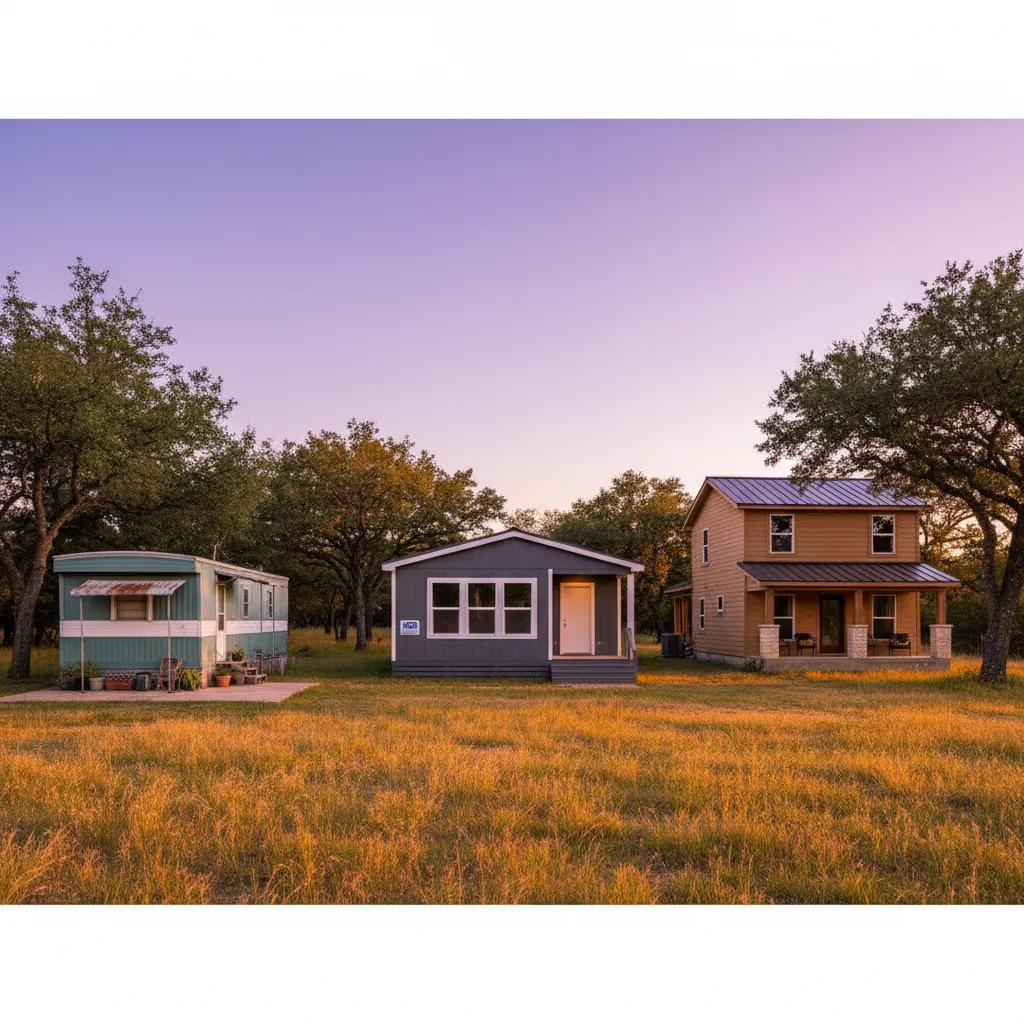
The terms "mobile home," "manufactured home," and "modular home" get used interchangeably every day, but they refer to three legally distinct categories of housing with very different building standards, financing options, and resale trajectories. A mobile home was built before June 15, 1976. A manufactured home was built on or after that date to the federal HUD Code. A modular home is built in a factory to the same state and local building code as a site-built house. Getting this right matters because it determines what loan you can get, what insurance costs, and how the home holds its value.
TL;DR: Mobile = pre-1976, no federal code, very limited financing. Manufactured = HUD Code (1976+), FHA/VA/chattel eligible, installed on chassis. Modular = state/local building code, permanent foundation, treated like a regular house for loans and appraisals.
Mobile Home: The Pre-1976 Classification
A mobile home is any factory-built home produced before June 15, 1976. That is not just a label, it is a legal definition baked into federal regulation. Before 1976, factory-built housing was not governed by any uniform national standard. Each manufacturer set its own construction specifications, and quality varied wildly. Many pre-1976 units used lightweight materials, lower R-value insulation, aluminum wiring, and fire-vulnerable designs that would not meet today's minimums.
Because of that, pre-1976 mobile homes are not eligible for FHA, VA, USDA, or most conventional financing. Insurance carriers often refuse to write policies on them as well. In Texas, you can still legally buy, sell, and occupy a pre-1976 mobile home, but the transaction is almost always cash, and many manufactured home communities will not accept one for placement.
If you see a listing marketed as a "1975 mobile home," assume it is a cash-only purchase with limited resale options. There is nothing wrong with that for the right buyer, but go in with your eyes open.
Manufactured Home: Built to the HUD Code
On June 15, 1976, the HUD Manufactured Home Construction and Safety Standards (commonly called the HUD Code) took effect. Every factory-built home that rides on a permanent chassis and is built to these federal standards is legally a manufactured home. The HUD Code preempts local building codes and covers structure, fire resistance, plumbing, electrical, heating, cooling, energy efficiency, and transportation.
Every HUD-compliant manufactured home has a red metal certification label (the HUD tag) on the exterior of each transportable section and a data plate inside (typically in a kitchen cabinet, laundry room, or primary bedroom closet). To learn more about where these are located and how to decode them, see our guide on reading a manufactured home HUD tag and data plate.
Manufactured homes come in three main size configurations: single-wide, double-wide, and triple-wide. For a deeper dive on layouts and dimensions, see mobile home sizes and layouts. Financing options include FHA Title I and Title II, VA loans, USDA loans, conventional Fannie Mae MH Advantage, and chattel loans for homes in leased-lot communities.
Modular Home: Built to the Same Code as a Stick-Built House
A modular home is factory-built in sections (often called "modules") that are transported to the site and assembled on a permanent foundation. The critical difference is that modular homes are built to the state and local building code of the final destination, not the federal HUD Code. In Texas that means the International Residential Code (IRC) with local amendments.
Because modular homes meet the same code as a site-built house, they are treated like site-built houses by lenders, appraisers, and county tax assessors. They go on permanent foundations, carry traditional mortgages, and generally appreciate along with the broader real estate market. From the street, a finished modular home is visually indistinguishable from a conventional house.
The trade-off is cost. Modular homes are more expensive per square foot than manufactured homes, and the savings versus a stick-built house are modest, usually 10-20%. Buyers choose modular for speed of construction and quality control, not for rock-bottom pricing.
Side-by-Side Comparison
| Category | Mobile Home | Manufactured Home | Modular Home |
|---|---|---|---|
| Build date | Before June 15, 1976 | June 15, 1976 or later | Any year |
| Building standard | None (manufacturer only) | Federal HUD Code | State/local IRC |
| Built on a chassis? | Yes | Yes | No |
| Foundation | Usually piers | Piers or permanent | Permanent only |
| Typical financing | Cash only | FHA, VA, chattel, conventional | Conventional, FHA, VA |
| Resale behavior | Depreciating | Stable to appreciating | Appreciates like site-built |
| Property classification | Personal property | Personal or real | Real property |
What Texas Buyers Usually Find For Sale
In the Austin, Central Texas, and greater Texas resale market, the overwhelming majority of inventory is used manufactured homes built between 1995 and 2015. These are HUD Code homes with full financing eligibility and solid resale potential. Pre-1976 mobile homes still exist in rural parks and older neighborhoods, but they are a small slice of active listings.
Modular homes are less common in the resale market simply because they are often indistinguishable from site-built houses on MLS listings. If you see a home described as "modular" or "panelized," it is usually priced similarly to site-built housing in the same area.
For most Texas buyers looking for affordable homeownership, a well-maintained manufactured home offers the best balance of upfront cost, financing flexibility, and long-term value. Our guide on used vs new manufactured homes breaks down why used inventory often wins on price per square foot. The Consumer Financial Protection Bureau also has good consumer guidance on manufactured home lending.
How Texas Classifies Each Type
Texas classifies manufactured homes under the Texas Department of Housing and Community Affairs (TDHCA) Manufactured Housing Division. Ownership is tracked through a Statement of Ownership rather than a DMV title, and homes can be elected as personal or real property. For a full breakdown of state-level rules, see our post on Texas manufactured home regulations.
Modular homes, by contrast, are treated as real property from day one. They are recorded with the county clerk and appraised by the county appraisal district like any other house. Mobile homes (pre-1976) are also under TDHCA jurisdiction, but their limited financing options and insurance challenges make them a niche category.
Frequently Asked Questions
Are mobile homes and manufactured homes the same thing?
No. Legally, homes built before June 15, 1976 are mobile homes, and homes built on or after that date to the HUD Code are manufactured homes. Everyday speech blurs the line, but lenders, insurers, and TDHCA treat them as distinct categories. When in doubt, look for the red HUD certification label on the exterior, which only appears on post-1976 manufactured homes.
Do modular homes qualify for regular mortgages?
Yes. Because modular homes are built to the same IRC code as site-built houses and sit on permanent foundations, they qualify for conventional, FHA, and VA mortgages with the same terms as a stick-built home. Appraisers treat them as standard real property.
Which holds its value better: manufactured or modular?
Modular homes generally appreciate in line with the local real estate market, similar to site-built houses. Manufactured homes on owned land with permanent foundations also appreciate, though typically at a slower rate. See our post on do manufactured homes depreciate for the Texas-specific data.
Can you still buy a pre-1976 mobile home in Texas?
You can, but financing is extremely limited and many insurers will not write a policy. Most pre-1976 transactions are cash sales, and many parks will not accept a pre-1976 unit for placement. If you plan to finance or insure the home, look for a post-1976 manufactured home with a visible HUD tag.
What does the HUD Code actually cover?
The HUD Code (24 CFR Part 3280) covers construction, fire safety, plumbing, electrical, heating and cooling, thermal protection, and transportation. It is a performance-based federal standard that preempts local codes for manufactured housing, which is why a manufactured home built in Waco can be shipped to and installed anywhere in Texas without re-permitting for structural compliance.
Is a park model home the same as a manufactured home?
No. Park models are recreational vehicles under 400 square feet, built to RVIA standards, not the HUD Code. They are designed for seasonal or recreational use, not permanent residency, and have very different zoning, tax, and financing rules.
Shopping for a manufactured home in Texas and want to be sure you're looking at the right classification? Mobile Buy Buy helps buyers identify HUD-compliant homes, verify documentation, and avoid costly misclassification mistakes. Call (737) 777-9437 or send a buyer inquiry and we'll walk you through the options.