
Putting a Manufactured Home on Family Land in Texas: Septic, Utilities and County Permits
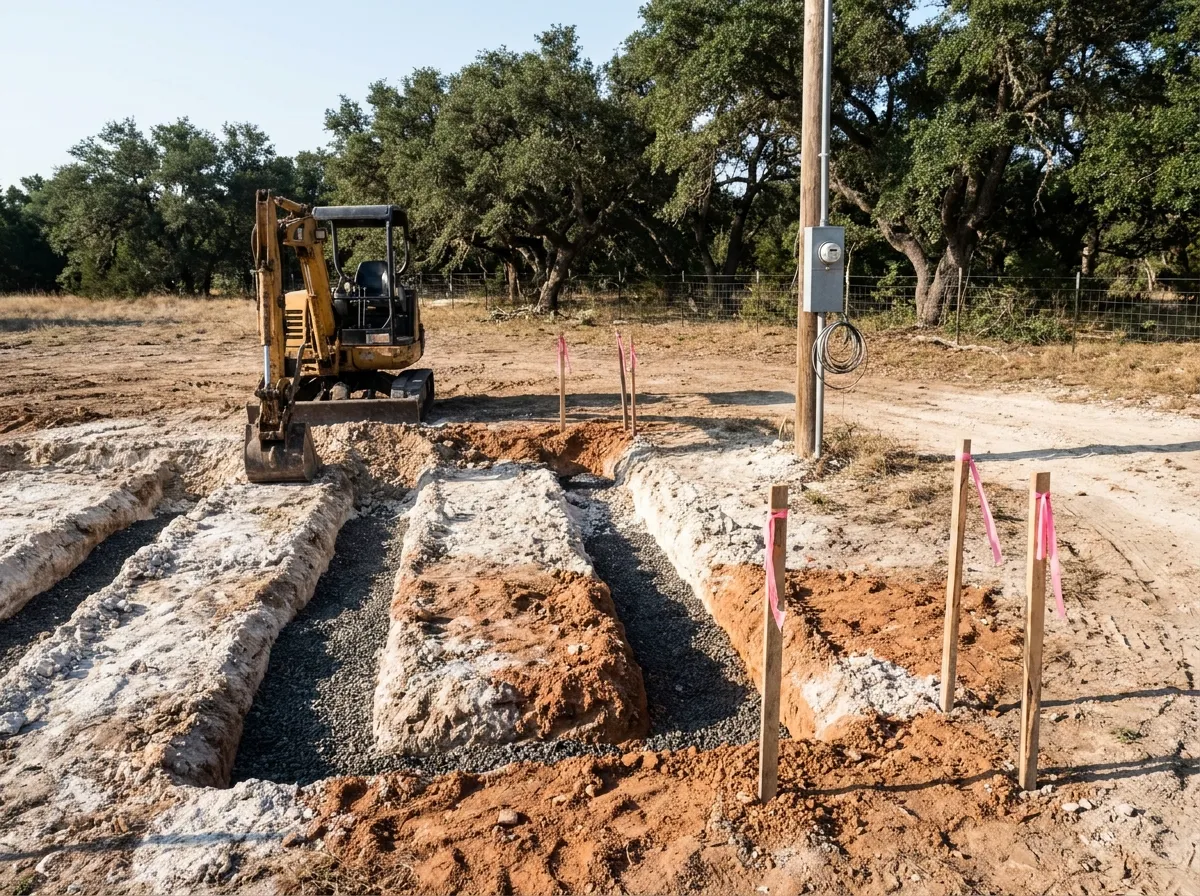
The phone call usually sounds like this. Grandmother has ten acres outside Lockhart, or Bastrop, or Luling. There is room for another home. Somebody found a nice used double-wide. How hard can it be?
The home is genuinely the easy part. Everything underneath it and connected to it is where the time and the money go, and on raw Texas acreage the order you do things in matters more than almost anything else.
Start with the thing that can kill the project: septic
If the land does not have a working, permitted on-site sewage facility with capacity to spare, sewage is the constraint that decides whether the project happens at all. Not the home. Not the driveway. Sewage.
On-site sewage facilities in Texas are regulated by the Texas Commission on Environmental Quality under 30 Texas Administrative Code Chapter 285. TCEQ writes the rules. It usually does not issue your permit.
Authorized agents. TCEQ delegates day-to-day permitting to local governments that have applied and been approved as authorized agents, typically a county or a county health district, operating under an order or ordinance approved by TCEQ. Where an authorized agent exists, that local office reviews your application, issues the permit and inspects the installation. Where one does not exist, the work runs through a TCEQ regional office instead. Your first call is therefore to the county, not to Austin.
The lot size rule people trip on. For subdivisions of single-family dwellings platted or created after the rule's effective date, using individual on-site sewage facilities, 30 TAC 285.4 sets minimum lot sizes: at least one-half acre where the lot is served by a public water supply, and at least one acre where it is not. On a large family tract this is rarely the binding issue. It becomes one the moment someone starts carving off a piece for the new home, which is a very common plan and a very common surprise.
Sizing follows bedrooms and soil. The design flow for an OSSF is driven by the dwelling, and the treatment and disposal method is driven by a site and soil evaluation performed by a licensed site evaluator or professional engineer. Blackland clay in eastern Travis, Caldwell and Bastrop counties does not percolate the way sand does, which is exactly why conventional drainfields are often ruled out around here and aerobic systems with spray fields are common. An aerobic system also carries an ongoing maintenance contract obligation, which is a real recurring cost that nobody mentions during the excitement of buying the home.
What a Texas county can and cannot require
This is genuinely different from most states and it confuses buyers moving in from elsewhere.
Texas counties do not have general zoning authority. A commissioners court cannot adopt a comprehensive zoning ordinance for unincorporated land. Under Texas Local Government Code Chapter 232 a county may adopt rules governing plats and subdivisions in the unincorporated area, but the statute expressly withholds the power to regulate the use of a building or property for residential, business or industrial purposes, the bulk, height or number of buildings on a tract, the size of a building, or the number of residential units per acre.
What counties do control in unincorporated Texas is narrow but decisive:
- On-site sewage facilities, where the county is the authorized agent.
- Subdivision platting under Chapter 232, if you are dividing land.
- Floodplain development permits, which counties administer to keep the community in the National Flood Insurance Program. A home in a mapped floodplain will face elevation requirements, and along the Colorado, the San Marcos and the Blanco this is not theoretical.
- Driveway and culvert permits where the property ties into a county road.
- Address assignment for 911, which you will need before utilities will set service.
And if the land sits inside a city's extraterritorial jurisdiction, Local Government Code Chapter 242 governs how the city and county divide subdivision authority there. Austin, San Marcos, Kyle, Buda and Georgetown all have meaningful ETJs. Land that feels rural can still be inside one.
Utilities, in the order they actually happen
Water. Either a public supply or a well. A public tap means a retail water utility, frequently a water supply corporation out here, with its own service application, capacity fee and line extension policy. Rural water supply corporations can have waiting lists and meaningful extension costs if the main is not already at your frontage. A well means a licensed water well driller, a Texas Department of Licensing and Regulation licensed installer, and in parts of Central Texas a groundwater conservation district registration on top of that.
Electric. In most of the rural Austin metro this is an electric cooperative such as Pedernales or Bluebonnet rather than a retail provider you choose. A service drop to a new location involves a work order, a staking visit, a construction estimate if the pole line has to be extended, and an inspection of your meter loop. The meter pole and loop are your cost, not theirs.
Gas. Usually propane out here, which means a tank, a set, and a supplier account.
Each of these has its own lead time and none of them are fast. Running them in parallel rather than in sequence is the single biggest thing you can do to compress the schedule.
The home side: installation and the ownership record
Once the site is ready, the manufactured home piece has its own requirements.
The set has to be performed under a TDHCA installer license. TDHCA defines an installer as a person, including a retailer or manufacturer, who contracts to perform or performs an installation function on manufactured housing, and its licensing guidance is clear that the person contracting with the consumer must hold the license even if the work is subcontracted.
The installer must file a Notice of Installation, Form T, with TDHCA within seven days of installation, and within three days for a provisional licensee. TDHCA's stated reason for the short window is that it wants to be able to inspect the installation before skirting goes on and covers it. That inspection is free leverage. Make sure your installer files on time and do not let the skirting crew get ahead of it.
The blocking, piers, anchoring and tie-down design come from the manufacturer's instructions and TDHCA's installation standards in 10 TAC Chapter 80. If you are considering something more permanent, our comparison of pier, slab and permanent foundations explains what each one costs you in flexibility later.
Separately, the ownership record has to reflect the new location. That runs through the Statement of Ownership at TDHCA.
The real property question, and why it comes up here
On family land there is usually a decision to make about whether the home stays personal property or becomes part of the real estate.
Keeping it personal property keeps it movable and keeps the home legally separate from the land, which matters when several family members have an interest in the tract. Electing real property treatment ties the home to the land, generally opens up conventional mortgage financing for a future buyer, and changes how it is taxed. We cover the mechanics in converting a manufactured home to real property in Texas.
There is no universally right answer. The question to ask honestly is whether the home and the land will always be sold together. If the family situation makes that unlikely, conversion works against you.
A realistic sequence
- Confirm who the OSSF authorized agent is for that county, and what they require.
- Order the site and soil evaluation. Get the OSSF design and cost before anything else.
- Check the FEMA flood map for the specific building site, not the parcel generally.
- Check the deed for restrictions. Old family deeds in Texas carry restrictions more often than people expect, and a private deed restriction can prohibit manufactured housing on land where the county has no say at all.
- Get written service availability and cost from the water provider and the electric co-op.
- Confirm whether you are inside a city ETJ and whether any division of the land triggers platting.
- Only then buy the home, and buy it with a licensed installer already engaged.
Doing step seven first is the most expensive mistake available in this process, because a home sitting on a lot with no approved septic design is a home you are storing, not living in.
If you are still weighing whether land is the right move at all, our side-by-side on a community lot versus private land lays out the tradeoffs before you get this far in.
This article is general information about Texas permitting for manufactured housing. It is not legal or engineering advice. OSSF rules, county authorized agent status, floodplain maps, platting requirements and utility policies vary by county and provider and change over time. Confirm current requirements with TCEQ, your county, your utility providers and TDHCA before making decisions.
Sources: TCEQ On-Site Sewage Facilities program; TCEQ OSSF Authorized Agents; TCEQ RG-472, On-Site Sewage Facility Rules Compilation (30 TAC Chapter 285); Texas Local Government Code Chapter 232, County Regulation of Subdivisions; TDHCA Manufactured Housing Licensing FAQ; TDHCA Notice of Installation (Form T)