
Manufactured Home Foundations: Pier, Slab, and Permanent Compared
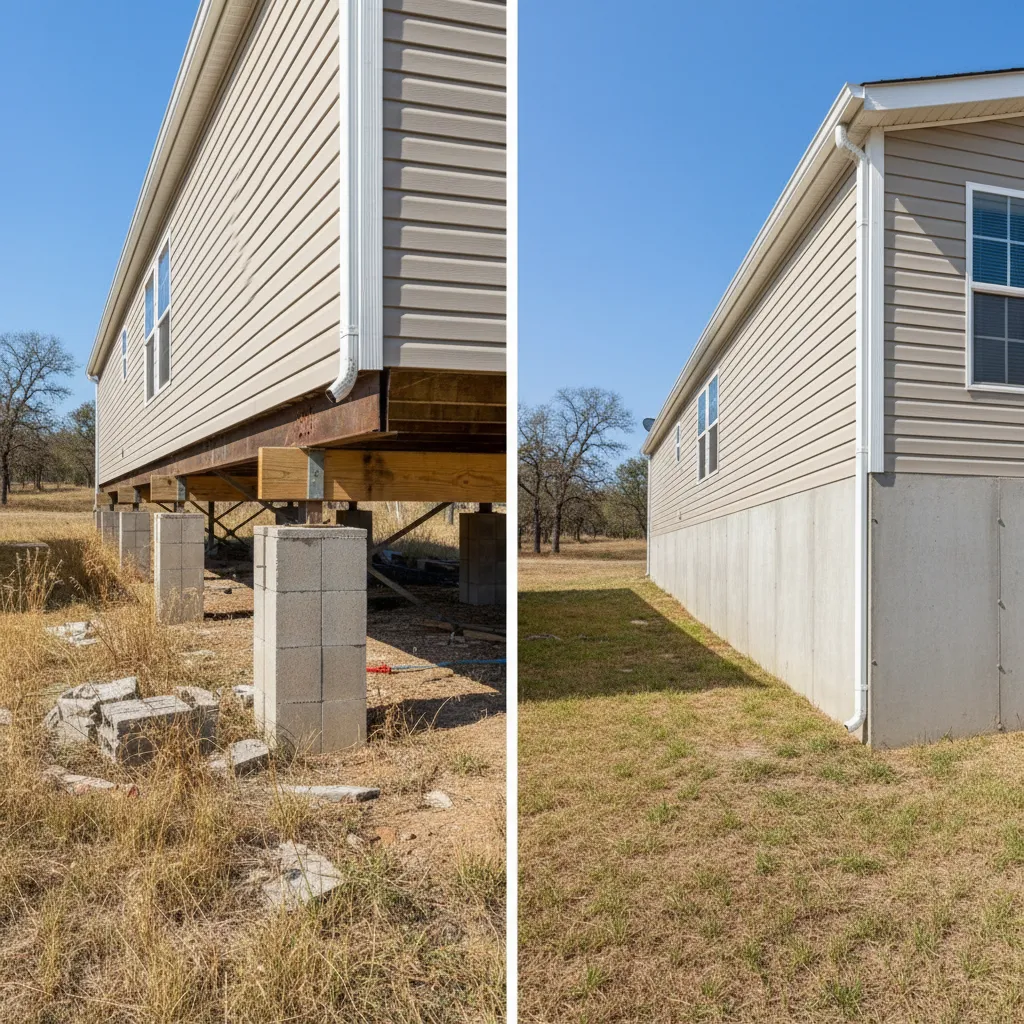
The foundation under a manufactured home determines everything that matters financially: which loans you qualify for, how much the home will be worth in 10 years, whether it can be titled as real property, and whether insurance will pay out after a storm. Texas allows four main foundation systems for manufactured homes, each meeting a different HUD Installation Standard. This guide breaks down pier and beam, runner with piers, full slab, and full perimeter permanent foundations, with real Texas costs, lender requirements, and the engineering certification every mortgage-financed sale requires.
Quick Answer: A pier and beam foundation is cheapest and most common but qualifies only for chattel loans. A full perimeter permanent foundation with engineer certification qualifies for FHA Title II, VA, USDA, and conventional mortgages. In Texas, a permanent foundation costs $8,000 to $30,000 depending on size and soil, plus $500 to $1,500 for the Professional Engineer (HUD-7) certification.
Why Foundation Type Matters So Much
The foundation is the single biggest factor separating a "mobile home" (chattel, personal property, auto-loan-style financing) from a "manufactured home" (real property, 30-year mortgage, conventional appreciation). A permanent foundation plus a land deed plus a TDHCA real-property election unlocks:
- Rates 2 to 4 percent lower than chattel loans.
- 30-year terms instead of 15 to 25 years.
- Conventional, FHA, VA, and USDA loan eligibility.
- Real property appreciation instead of chattel depreciation.
- Homestead exemption (if principal residence).
- Better insurance rates with standard HO-7 carriers.
- Higher resale value (typically 15 to 25 percent more than identical home on piers alone).
For the conversion process, read our Texas manufactured home regulations guide.
Foundation Types at a Glance
Four systems cover virtually every legal manufactured home installation in Texas. They differ in cost, permanence, and loan eligibility.
| Foundation | Cost (Doublewide) | Permanent? | FHA Title II? | VA? | Conventional? |
|---|---|---|---|---|---|
| Pier and Beam | $2,500 to $5,000 | No | No | No | No |
| Runner with Piers | $4,000 to $8,000 | Sometimes* | Rarely | Rarely | No |
| Concrete Slab (with anchors) | $8,000 to $18,000 | Yes (with PE cert) | Yes | Yes | Yes |
| Full Perimeter Block/Concrete | $12,000 to $30,000 | Yes | Yes | Yes | Yes |
*Runner with perimeter skirt wall and PE cert can qualify. Most lenders still require full perimeter.
Pier and Beam (Non-Permanent)
This is the factory default and what 80 percent of Texas manufactured homes sit on. Concrete pads (typically 16x16 inch or 24x24 inch) rest on compacted soil. Adjustable steel or concrete piers sit on the pads, supporting the home's I-beam chassis rails. Earth anchors with tie-down straps connect the chassis to the ground.
Pier and beam meets HUD Installation Standards and TDHCA requirements. It is fast (1 to 2 days), cheap, and easy to re-level. But it is not a permanent foundation: the home can theoretically be moved, so lenders treat it as personal property.
Runner with Piers
A continuous concrete runner (strip footing) poured under each chassis rail, with piers still supporting the frame. Runners improve load distribution on soft soils and can qualify as permanent if combined with a structural perimeter skirt wall tied into the runners and a PE certification. In practice, most lenders still want full perimeter.
Concrete Slab
A full-floor concrete slab (monolithic or with thickened edges) with embedded J-bolts or post-tension anchor straps. The home sits directly on the slab with blocks and shims under the chassis. With a perimeter skirt wall and engineer certification, the slab satisfies HUD PFGMH as a permanent foundation. Slabs are especially common in South Texas where frost is a non-issue and expansive clay soils benefit from continuous support.
Full Perimeter Permanent (Block or Poured Concrete)
The gold standard. A continuous wall of concrete masonry units (CMU) or poured concrete runs the full perimeter of the home, extending below the local frost line (minimal in Texas, typically 12 to 18 inches). The chassis is anchored to the wall with approved connectors. A vapor barrier covers the crawl space. Vent openings meet the 1 sq ft per 150 sq ft standard.
This is what FHA Title II, VA, USDA, Freddie Mac CHOICEHome, and Fannie Mae MH Advantage expect when they say "permanent foundation." It qualifies for every manufactured home loan product in Texas.
What "Permanent" Actually Means to Lenders
Every federally backed loan defines permanent foundation by reference to the HUD Permanent Foundations Guide for Manufactured Housing (PFGMH). The guide is explicit about what qualifies. A Texas-licensed Professional Engineer must inspect and certify that the foundation:
- Provides vertical support for the home in all design load conditions.
- Resists lateral, uplift, and overturning forces from wind and seismic events.
- Is constructed of durable materials (concrete, masonry, pressure-treated wood per code).
- Is built on site (not prefabricated).
- Extends below frost line where applicable.
- Is properly anchored to the home's chassis with approved connectors.
- Is enclosed with a perimeter wall (not just skirting) that transfers loads to footings.
The guide lives in the federal register and is referenced by FHA at the HUD Single Family page and in the HUD Code (24 CFR Part 3280).
The Texas Engineer Certification (HUD-7 Letter)
Every FHA Title II, VA, and conventional closing on a manufactured home in Texas requires an engineer certification. The form most commonly used is a modified HUD-7 foundation certification letter, signed and stamped by a Texas-licensed PE.
What the engineer inspects:
- Physical foundation measurements and materials.
- Anchor placement, spacing, and load rating.
- Skirt wall or perimeter wall construction.
- Chassis tie-down straps and connectors.
- Vapor barrier and ventilation.
- Vertical and lateral support compliance with PFGMH.
Cost: $500 to $1,500 depending on travel distance and home size. Schedule the inspection early; a failed cert can delay closing by 2 to 4 weeks while corrections are made. The certification is issued to the lender, not the homeowner, and is kept in the loan file.
Choosing the Right Foundation for Your Situation
Match foundation to your plan, not the other way around.
If You Are Placing in a Park on Leased Land
Pier and beam is almost always correct. The park sets installation standards (often TDHCA minimum). You cannot title as real property without owning the land anyway, so there is no financial benefit to paying for permanent foundation. Focus the budget on quality skirting, anchors, and vapor barrier. See our inspection guide for what to verify at set.
If You Are Buying Land and Want FHA or VA
Go straight to full perimeter or slab with PE certification. The extra $10,000 to $20,000 is recovered within a few years through the rate difference between chattel (10 to 11 percent) and FHA (6 to 8 percent) on a $100,000 balance. See our complete financing guide for loan program detail.
If You Already Own and Want to Convert Later
Pier and beam installations can be retrofitted with a perimeter masonry wall later, but it is expensive and labor-intensive (typically $15,000 to $25,000 retrofit). Only worth it if you plan to refinance into a mortgage or sell to an FHA/VA buyer.
Foundation and Severe Weather in Texas
Texas manufactured homes face tornadoes, hurricanes, and hail. Foundation choice affects survival odds.
- Tornado Alley (North/Central TX): Full perimeter foundations perform substantially better than pier-only in EF-1 and EF-2 events.
- Hurricane coast (HUD Wind Zone II): TDHCA requires Zone II-rated anchors and tie-downs. Permanent foundations with engineered anchor placement outperform surface-installed earth anchors.
- Expansive clay soil (Central TX): Post-tensioned slabs resist soil movement better than individual pier footings on plastic clay.
- Flood zones: FEMA requires the lowest floor elevation to be at or above Base Flood Elevation. A pier foundation can satisfy this without a full permanent wall if engineered properly.
Frequently Asked Questions
Can I convert a pier and beam foundation to permanent later?
Yes, but it is expensive. Retrofitting a permanent perimeter wall around a home already set on piers typically costs $15,000 to $25,000 and requires excavation, footing pour, block wall construction, anchor installation, and engineer certification. If you plan to convert within 5 years, it is usually cheaper to install permanent foundation at initial set.
Does a concrete runner count as a permanent foundation?
Alone, no. A concrete runner supports the chassis beams but does not enclose the crawl space. To qualify as permanent for FHA and conventional loans, the runner system must be combined with a load-bearing perimeter wall (masonry or concrete) tied into the runners. Most lenders still prefer a true full perimeter over runner-plus-skirt.
What is the difference between an anchor and a pier?
A pier is a vertical support (steel or concrete block) that holds the chassis up off the ground. An anchor is a ground-embedded device (typically a 4-foot helical auger) connected to the chassis by diagonal straps to resist wind uplift and lateral forces. Every Texas manufactured home needs both. TDHCA specifies anchor spacing based on home length and wind zone.
How long does it take to install a permanent foundation?
A full perimeter masonry foundation on a prepared site takes 7 to 14 days: 1 day to excavate, 1 day to pour footings, 3 to 4 days of cure time, 2 to 3 days of block or poured wall construction, and 1 to 2 days for anchor and chassis connection. Add a few days if soil conditions are poor or weather delays occur. Engineer cert usually happens the week after completion.
Do I need a permit for foundation work on a manufactured home in Texas?
It depends on the county. Unincorporated areas of most Texas counties do not require building permits for manufactured home foundations. Incorporated cities and HOA-governed subdivisions often do, especially for permanent foundations. Always call the local building department before breaking ground. The TDHCA installation permit is separate and is always required.
Need help deciding what foundation fits your loan program and budget? Mobile Buy Buy coordinates with TDHCA-licensed installers and Texas PEs across Central Texas. Call (737) 777-9437 or submit a buyer inquiry and we will walk the property with you before you spend a dollar on dirt work.