
Re-Leveling and Pier Repair in Texas: What It Involves and When It Means Something Worse
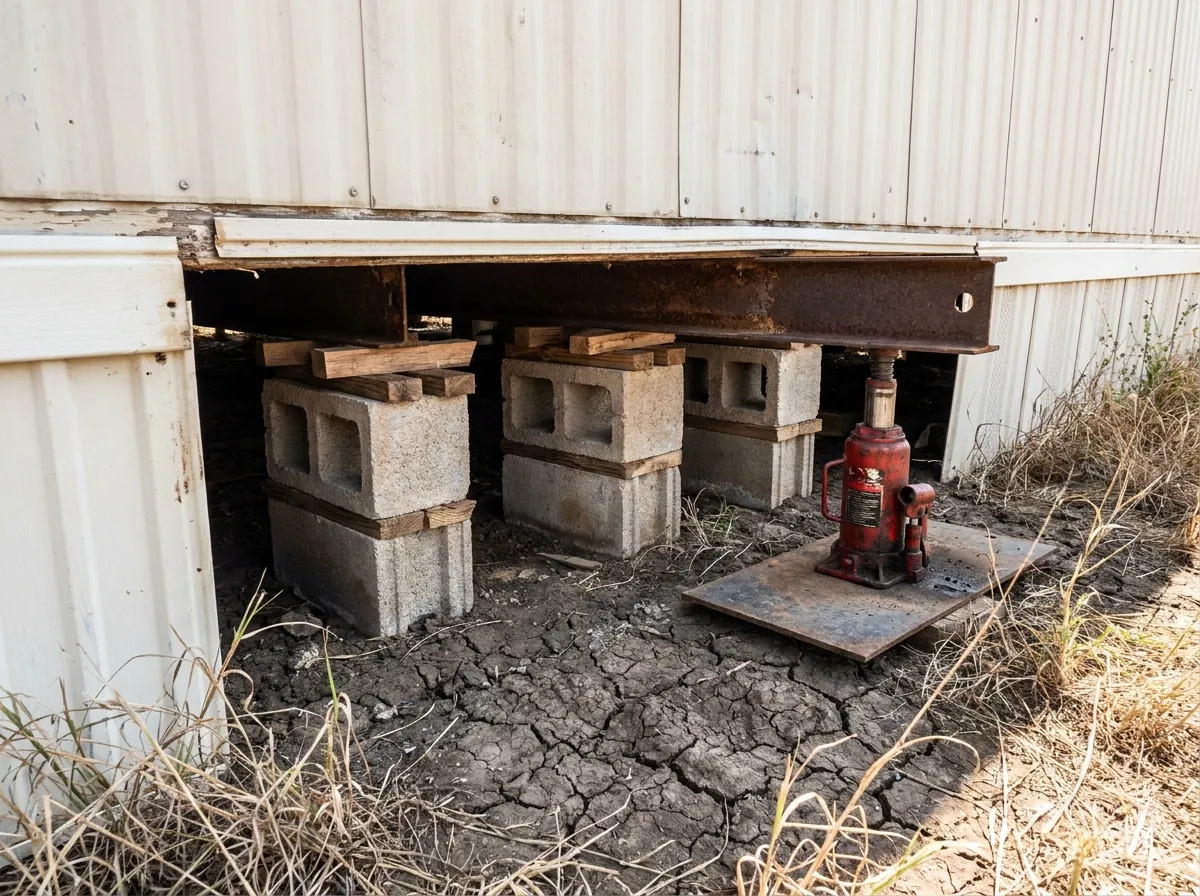
If you own a manufactured home east of I-35 in Central Texas, you are going to re-level it. Not because it was set badly. Because of what is under it.
This is one of the few genuinely regional facts about manufactured housing here, and it is worth understanding the mechanism rather than just being told to call somebody.
Why Central Texas soil does this
Texas's state soil is the Houston Black series, a deep, dark Vertisol that runs across the Blackland Prairie through the eastern side of the Austin metro and down through Caldwell, Bastrop, Williamson and Bell counties. Its dominant clay mineral is smectite, specifically montmorillonite.
Montmorillonite has a layered crystal structure that pulls water molecules in between its layers. When water goes in, the clay physically swells. When the soil dries, the water leaves and the clay contracts. On a classic Vertisol the contraction is dramatic enough that the ground pulls itself apart into wedge-shaped blocks with wide, deep cracks that stay open for months in a dry Texas summer. Anyone who has walked a pasture in Manor or Lockhart in August has seen it.
Now put a manufactured home on it.
The home does not sit on a monolithic slab that moves as one piece. It sits on a grid of individual piers, each resting on its own footing pad, each carrying its own share of the load. When the clay under pier number 14 swells two inches and the clay under pier number 3 does not, the frame twists. That differential movement, repeated every drought and every wet spell, is what puts a home out of level.
Two things make it worse, and both are in your control. Trees close to the home pull moisture out of the soil on one side, drying that side faster. And water discharging off the roof at one corner keeps that corner wetter than the rest. Uneven moisture is the actual enemy, not moisture generally.
What a real re-level involves
A proper re-level is not somebody kicking a shim back into place.
The home is lifted at the chassis, not the floor. Jacks go under the steel I-beams of the frame. Lifting a manufactured home at the floor decking or at a joist damages it. This is the most common thing an unlicensed handyman gets wrong.
Every pier is checked, not just the ones that look bad. Piers get evaluated for plumb, for crushed or cracked block, for missing or compressed shims, and for whether the footing pad has sunk into the clay. On a home that has been down twenty years it is normal to find pads that have pressed themselves several inches into the ground.
Shims are wood, in pairs, and they are supposed to be snug. Loose shims that have fallen out are a symptom, not the cause. Replacing them without addressing why the pier dropped just buys a season.
Tie-downs and anchors get re-tensioned. Anchors and straps are part of the installation, and after a lift they are slack. Rusted straps and anchors that have worked loose in the clay get replaced. This is also the moment to look at whether the anchor pattern matches what the manufacturer's manual calls for, which on older homes it often does not.
On a multi-section home, the marriage line gets re-checked. The two halves have to come back into alignment. So does the crossover duct underneath, which is frequently found crushed, disconnected or lying on the ground, and which is quietly costing the owner money on every cooling bill.
Expect cosmetic cracking afterward. Drywall seams, trim joints and ceiling corners will show some movement when a home comes back to level. That is normal.
In Texas this work is licensed. TDHCA defines an installer as a person who contracts to perform or performs an installation function on manufactured housing, and re-leveling is an installation function. The person who contracts with you must hold that license even if they subcontract the labor. Verify it on TDHCA's public licensee search before you hire.
What drives the cost
Rather than quote figures that go stale, here is what changes the number:
- Single-section versus multi-section. Two halves means twice the pier grid and a marriage-line alignment.
- How far out of level it has drifted. A quarter inch of correction is a different job from three inches.
- Access. Low ground clearance, a tight skirting cavity, and standing water underneath all slow the crew down.
- How many piers actually need rebuilding. Re-shimming is cheap. Excavating a sunken footing, pouring a new pad and rebuilding the pier stack is not.
- Skirting. It has to come off and go back on. Damaged panels get replaced, and older skirting is often brittle enough that it does not survive removal. Our guide to skirting types and installation in Texas covers what you are dealing with there.
- Whether anchors have to be replaced. Driving new anchors in clay is its own line item.
When re-leveling is a symptom of something bigger
This is the part worth reading twice, because a re-level can be a routine maintenance item or it can be the first visible sign of a problem that re-leveling will not fix.
You are re-leveling far more often than you used to. A home that needed attention every several years and now needs it annually is telling you something changed under it. Usually drainage. Sometimes a leak.
There is standing water or damp ground under the home. Clay plus persistent moisture at one location is a pier that will keep sinking. The fix is grading, gutters and downspout extensions, not another lift. Chasing level without fixing drainage is spending money on the same job repeatedly.
Piers are sitting on inadequate footings. Concrete block set directly on soil, footing pads that are undersized for the load, or piers that were never there at all under a section of the home. That is an installation defect, and it is common on homes that were moved by someone unlicensed.
The floor is still soft after the home is level. This is the big one. If a spot in the floor still flexes when you step on it after the home has been brought back to level, the problem is the floor structure, not the piers. That is almost always long-term water: a supply line, a drain, a tub surround, or a roof leak that traveled. Decking and joists rot, and no amount of jacking repairs rotted wood.
Doors and windows do not come back into square. After a competent re-level, doors should latch and windows should operate. If they do not, the frame or the floor system has taken a set, which means the movement has been going on long enough to cause permanent deformation.
The steel frame is visibly bent, cracked or heavily rusted. Chassis damage is a different conversation entirely, and it usually shows up on homes that were moved without proper preparation.
Anchors have pulled or straps are severed. That is a safety issue rather than a comfort issue, and it matters a great deal in a state that gets both severe thunderstorm winds and, in the eastern counties, tropical systems.
What to do about it as a buyer
Take the level question seriously during inspection. Our manufactured home inspection guide covers the full walkthrough, but the specific things to do here are:
Put a marble or a level on the floor in several rooms. Open and close every exterior door and several windows. Get under the skirting with a flashlight and look at the pier grid, the footing pads, the anchor straps, the crossover duct and the ground condition. Look at where the roof water goes, and how close the trees are.
Then ask the seller directly when it was last re-leveled and by whom. An owner who says "twice in the last three years" has just told you the real condition of the site, whatever the home looks like inside.
The unglamorous prevention
Most of what keeps a Texas manufactured home level is water management, and it is cheap compared to repeat lifts.
Gutters with downspouts that discharge well away from the perimeter. Grade that falls away on all sides. A vapor barrier on the ground under the home. Skirting vented as the manufacturer intends rather than sealed up tight. Large trees at a sensible distance. And in a severe drought, keeping the perimeter soil evenly damp rather than letting one side bake while the shaded side stays moist.
None of that stops Blackland clay from doing what it does. It does keep the movement more uniform, and uniform movement is what your pier grid can tolerate.
This article is general information about manufactured home installation and maintenance in Texas. It is not engineering advice. Installation standards, licensing requirements and manufacturer instructions vary and change. Have work performed by a TDHCA-licensed installer and consult a licensed engineer for suspected structural damage.
Sources: TDHCA Manufactured Housing Licensing FAQ; TDHCA Manufactured Housing Laws and Rules, 10 TAC Chapter 80; USDA NRCS, Houston Black, the Texas state soil