
Moving a Manufactured Home in Texas: Permits, Cost Drivers, and Who Is Actually Licensed to Do It
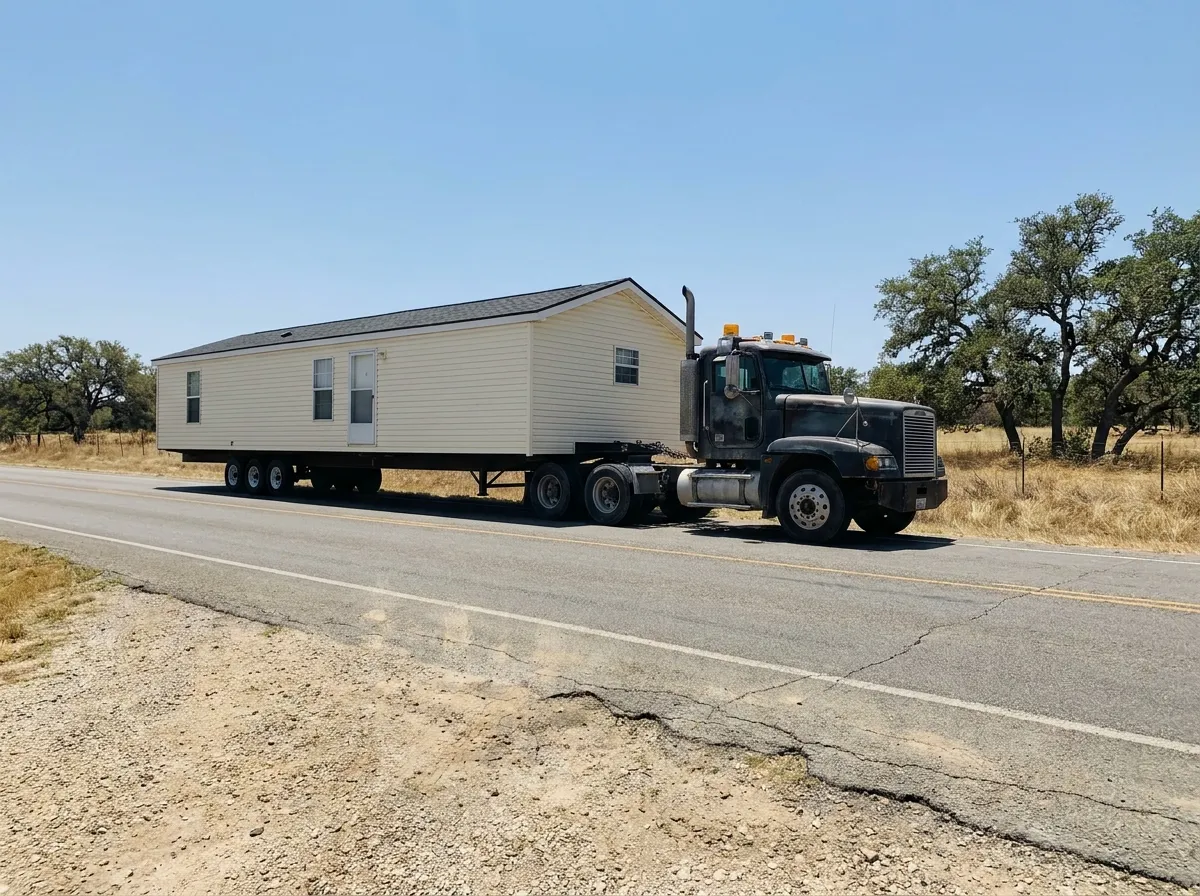
People price a move by asking a hauler for a number. That is the wrong first question, because the haul is only one of five jobs, and it is usually not the one that blows up the budget.
A Texas relocation is a permitted oversize transport run regulated by one agency, followed by a licensed installation regulated by a completely different agency, with a county or city in the middle deciding whether the home is allowed to land where you want it. Understanding who controls what is how you stop getting surprised.
Two agencies, two different jobs
This trips up almost everyone, so it is worth being blunt about it.
The Texas Department of Motor Vehicles moves the home. TxDMV's Motor Carrier Division issues the oversize and overweight permits that make it legal to put a manufactured home on a Texas highway. That is the transport side, and it ends the moment the home is parked on the destination lot.
The Texas Department of Housing and Community Affairs regulates the home itself. TDHCA licenses the people who install it, sets the installation standards in 10 Texas Administrative Code Chapter 80, and maintains the ownership record. TxDMV does not care how the home is blocked and anchored. TDHCA does.
A hauler who quotes you a transport price has quoted the TxDMV half. If nobody has priced the TDHCA half, you do not have a real number yet.
The TxDMV permit, specifically
Manufactured housing gets its own permit category at TxDMV rather than riding under a general oversize permit.
A manufactured housing single-trip permit covers one movement, from one specific point of origin to one specific destination, during the window written on the permit, which TxDMV caps at five days. It is route-specific, so the approved path is the legal path. A shorter line on a map that crosses a restricted bridge is not an option.
Two categories of applicant can hold one. A motor carrier with a USDOT number, checked against federal out-of-service records, or a private homeowner who is named on the title of the home and owns or leases the towing vehicle. TxDMV requires that private homeowner to carry liability insurance of at least $300,000 combined single limit. As of this writing TxDMV publishes the single-trip permit fee at $40, which tells you how small a share of the true cost the permit itself represents.
Transport is prohibited on national holidays, and TxDMV names New Year's Day, Memorial Day, Independence Day, Labor Day, Thanksgiving Day and Christmas Day. If your closing or your lot-rent clock lands on a holiday week, build that in.
Escorts scale with width. Under TxDMV's escort and equipment rules, a load over 16 feet wide but not over 18 feet requires one escort, positioned in front on a two-lane highway and in the rear on a highway with four or more lanes. Over 18 feet wide requires two escorts, one front and one rear. That is why a wide multi-section home costs disproportionately more than a 14-foot single-wide: you are paying for additional vehicles and additional people for the entire route.
Who is licensed, and for what
TDHCA licenses several distinct roles in Texas manufactured housing, and they are not interchangeable:
- Manufacturer, which builds the home.
- Retailer, which sells or exchanges used homes as a business, including anyone maintaining a display lot.
- Retailer/Installer, a combined license, because a retailer selling a new home warrants the installation.
- Broker, which negotiates a sale of a titled home for someone else but does not maintain a display lot.
- Salesperson, held individually by each person selling for a retailer or broker.
- Installer, which is the one that matters for a move.
TDHCA defines an installer as a person, including a retailer or manufacturer, who contracts to perform or performs an installation function on manufactured housing. The department's own licensing guidance is explicit that the person contracting with the consumer must hold the installer license even if the physical work is subcontracted. So "my cousin does this" is not a compliant arrangement when money changes hands for the set.
Installers also have a reporting duty. TDHCA requires a licensed installer to file a Notice of Installation, known as Form T, within seven days of installation, and within three days for an installer holding a provisional license. The point of the deadline is that the department wants the chance to inspect the installation before the skirting goes on and hides it. If your installer is slow with the Form T, you lose the inspection window, and you lose the cheapest opportunity you will ever have to find out the set was done wrong.
You can verify any license on TDHCA's public licensee search before you sign anything. Do it. It takes two minutes.
The five jobs, and where the money actually goes
1. Disconnect and teardown. Skirting off. Water, sewer, electric and gas disconnected. Anything added after the original set, decks, porches, carports, add-on rooms, steps, has to come off or be demolished. Axles, wheels and a hitch have to be reinstalled if they were removed, and on an older Texas home sitting on blocks for twenty years, they usually were.
2. Permitting and routing. The TxDMV permit, run through the TxPROS routing system. Route difficulty is a real cost driver in Texas, where a rural county road network can force a long legal detour around a load-restricted bridge.
3. The haul. Licensed transporter, correct equipment, escorts by width, daylight and weather restrictions.
4. Set and level at the destination. Blocking, piers, leveling, anchoring and tie-downs to the manufacturer's instructions and TDHCA installation standards. If the home is going onto a permanent foundation, that is a separate construction job with its own cost. Our breakdown of pier, slab and permanent foundations covers what each of those actually means.
5. Reconnect and finish. Water, sewer or a new septic system, electric service drop, gas, skirting back on, steps and landings rebuilt. On raw land this is frequently the single largest line item, and it has nothing to do with the haul at all.
What actually drives the number
Rather than quote dollar figures that go stale within a season, here is what genuinely moves the total:
- Section count. A double-wide is two permitted loads, two hauls, and a marriage-line reassembly. It is normally more than twice a single-wide, not exactly twice.
- Width, because of escorts. The 16-foot and 18-foot thresholds in the TxDMV escort rules are hard steps in cost, not a smooth curve.
- Route, more than raw distance. Fixed costs on both ends are heavy. Doubling the mileage rarely doubles the bill, but a route forced sixty miles out of the way by a bridge restriction adds real money.
- Age and condition. Older homes are more fragile in transit, and some haulers decline pre-1976 homes outright. Homes built before 15 June 1976 predate the federal HUD Code, and many Texas communities and lenders will not accept them at all.
- Destination readiness. Owned land with existing utilities is a different project from raw acreage needing a septic permit, a well or a water tap, and an electric service drop.
The honest break-even
Add the full five-job cost plus destination site work. Compare it to what the home is realistically worth once it is set up and connected at the new location. Then compare that to what the home is worth right now, where it stands.
For a sound, newer multi-section home going onto land you already own with utilities in place, moving can pencil out. For a 1990s single-wide with a soft floor and a tired roof, the total relocation cost frequently exceeds what the home will be worth on arrival, and you end up having spent real money to still own an old home that now has transport stress in it.
That is not a pleasant conclusion, but reaching it before you spend anything is worth more than a cheap quote.
Before you commit to anything
Confirm three things in this order. That a destination will actually accept the home, including age restrictions and any deed restrictions on the receiving property. That a licensed installer will take the job and has looked at the destination site. That the ownership record can be updated to the new location, which runs through the Statement of Ownership at TDHCA.
If any one of those three is a no, the haul quote does not matter.
This article is general information about Texas permitting and licensing for manufactured housing. It is not legal advice. Permit requirements, fees, escort rules and local placement restrictions change. Confirm current requirements with TxDMV, TDHCA and the receiving county or city before making decisions.
Sources: TxDMV Manufactured Housing Single-Trip Permits; TxDMV Escort and Equipment Requirements; TDHCA Manufactured Housing Licensing FAQ; TDHCA Notice of Installation (Form T); HUD Manufactured Housing Program