
Mobile Home Park vs Private Land: Which Is Right for You?
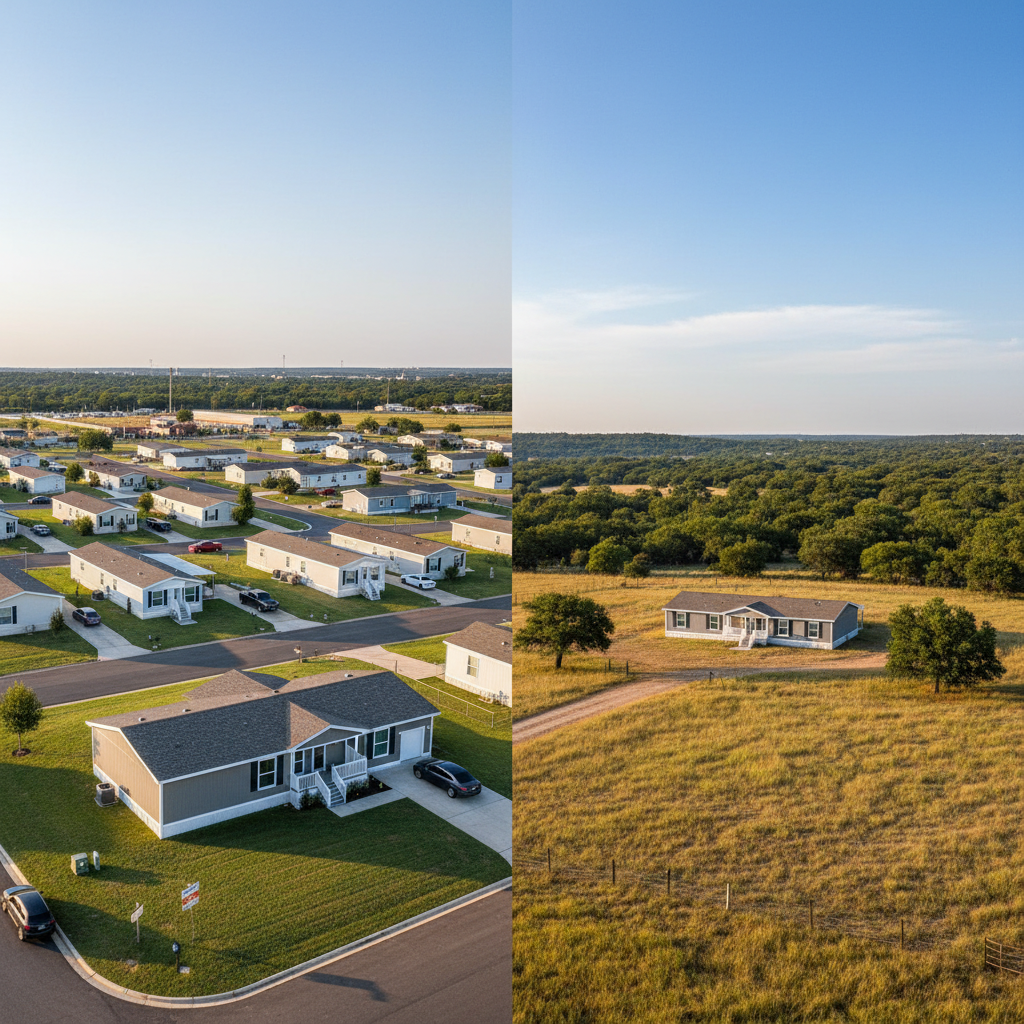
One of the first decisions you'll face when buying a manufactured home in Texas is where to put it. Should you place your home in a manufactured home community (often called a mobile home park) or buy your own land? Each option has distinct advantages and trade-offs, and the right choice depends on your budget, lifestyle preferences, and long-term financial goals.
Living in a Manufactured Home Community
Manufactured home communities range from basic parks to resort-style developments with clubhouses, pools, and organized activities. In Texas, there are over 4,000 communities across the state, concentrated around major metropolitan areas.
What You'll Pay
Community living involves two primary costs: the price of your home and a monthly lot rent. In Texas, lot rents typically range from $300 to $800 per month depending on location and amenities. Some upscale communities in the Austin or DFW areas charge $700 or more, while rural communities may charge as little as $250. Lot rent usually covers water, sewer, trash pickup, and common area maintenance, but confirm exactly what's included before signing a lease.
The Advantages
- Lower upfront cost: You only need to buy the home, not the land, which dramatically reduces your initial investment. A quality used single-wide might cost $25,000-$50,000 without the added expense of land.
- Built-in amenities: Many communities offer pools, playgrounds, community centers, laundry facilities, and organized social events.
- Maintenance simplicity: The community handles road maintenance, common area landscaping, and often some utility infrastructure.
- Ready infrastructure: Utility hookups, pads, and driveways are already in place, eliminating the cost and hassle of site preparation.
- Sense of community: Neighbors are close, social activities are available, and there's often a management team to address concerns.
The Disadvantages
- Lot rent increases: Unlike a mortgage payment that stays fixed, lot rent can increase annually. Some communities cap increases at 3-5% per year, but others have no limits. Over 10-20 years, cumulative rent increases can add up to significant amounts.
- Rules and restrictions: Communities set rules about pets, guests, exterior modifications, vehicle parking, and more. Some are reasonable; others can feel restrictive.
- No land equity: You're paying rent on land you'll never own, which means you're building equity only in the home itself.
- Community sale risk: If the community is sold to a new owner or redeveloped, residents may face displacement or significant rent increases.
- Limited appreciation: Homes in communities typically appreciate more slowly than those on private land, and may even depreciate modestly.
Placing Your Home on Private Land
Owning land gives you maximum control and long-term investment potential, but it comes with greater responsibility and upfront costs.
What You'll Pay
Land prices in Texas vary enormously by location. An acre of rural land two hours from a major city might cost $5,000-$15,000, while a half-acre lot on the outskirts of Austin or San Antonio could run $50,000-$150,000. Beyond the land purchase, you'll need to budget for:
- Site preparation and grading: $2,000-$8,000
- Utility connections (water, sewer/septic, electric): $5,000-$20,000
- Foundation installation: $3,000-$15,000
- Driveway and access road: $2,000-$10,000
- Septic system (if no municipal sewer): $5,000-$15,000
The Advantages
- Equity in land and home: You own everything, and land in growing Texas areas has historically been an excellent investment.
- Better appreciation: Homes on owned land with permanent foundations appreciate similarly to site-built homes.
- No lot rent: Your monthly costs are limited to your mortgage, property taxes, insurance, and utilities.
- Total freedom: No community rules about pets, guests, vehicles, or exterior modifications. Your property, your rules (within county regulations).
- Better financing: Once on a permanent foundation on owned land, your home qualifies as real property, opening up conventional mortgage options with lower interest rates.
- Privacy: More space between you and your neighbors, plus the ability to choose a rural or semi-rural setting.
The Disadvantages
- Higher upfront investment: Between land, site prep, utilities, and the home itself, you're looking at a significantly larger initial outlay.
- All maintenance is yours: Road access, septic systems, water wells, and property maintenance are entirely your responsibility.
- More complex process: Coordinating land purchase, site preparation, home delivery, and installation requires more planning and project management.
- Zoning restrictions: Some Texas counties have regulations about manufactured home placement, minimum lot sizes, or foundation requirements. Always check before buying land.
Making the Decision: Key Questions to Ask
- What's your budget? If you have limited savings, a community placement lets you get into a home faster with less cash upfront.
- How long will you stay? If you plan to live in the home for more than 5-7 years, owning land usually makes more financial sense due to equity building and avoiding cumulative lot rent.
- Do you value community or privacy? Some people thrive in the social environment of a community; others want space and independence.
- What are your financial goals? If building long-term wealth is a priority, land ownership provides the best path to appreciation.
- Can you handle property maintenance? Managing a septic system, well, or long driveway isn't for everyone. Be honest about your willingness and ability to handle these responsibilities.
Not sure which option is right for you? Mobile Buy Buy can help you weigh the pros and cons based on your specific situation and budget. Call us at (737) 777-9437 for personalized guidance.